Forklift aisle width and truck choice should be decided together, because each one sets the other. A counterbalance forklift needs roughly 11 to 13 ft of aisle, a reach truck roughly 8 to 10 ft, and a turret truck roughly 5 to 7 ft. Deciding them separately, often by different people at different times, is the most common expensive mistake in warehouse layout.
How Wide Should a Forklift Aisle Be by Truck Type?
Forklift aisle width depends on truck type: roughly 11 to 13 ft for a counterbalance truck, 8 to 10 ft for a reach truck, and 5 to 7 ft for a turret truck. These are working ranges, not exact figures. The real need depends on the specific truck, the load size and how much room to maneuver the operation wants.
- Counterbalance forklift (Class I, IV, V): roughly 11 to 13 ft. The truck carries the load ahead of its front wheels. So it needs room to turn the whole machine plus the load.
- Reach truck (Class II): roughly 8 to 10 ft. The forks reach forward into the rack instead of the truck driving in. So the machine stays in a narrower footprint.
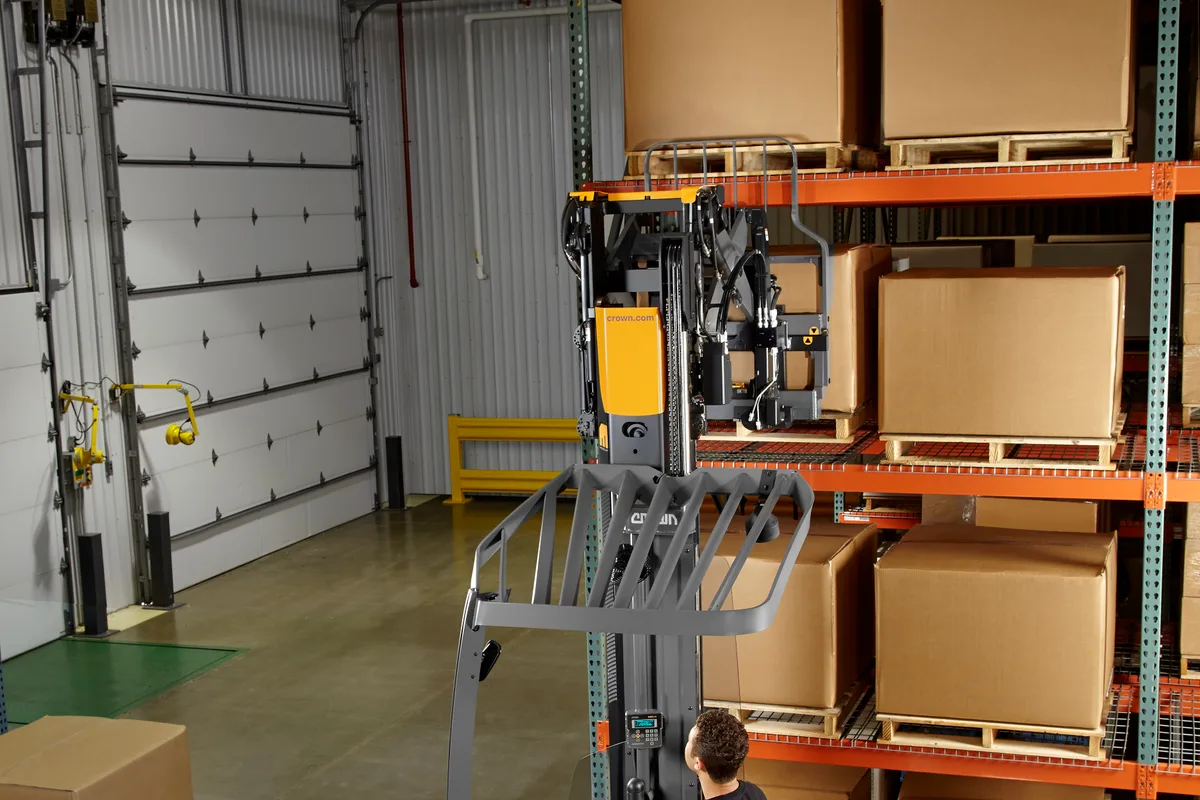
- Turret / very narrow aisle truck (Class II): roughly 5 to 7 ft. The load turns, not the truck. That is what lets the aisle be so narrow.
- Order picker (Class II): similar to a reach truck, often with guidance.
- Walkie stacker / pallet jack (Class III): roughly 6 to 8 ft for a stacker. A pallet jack needs little more than its own width plus turning room.
What Does Narrowing an Aisle Buy You?
Narrowing an aisle gains storage space, and the gain is biggest in tall buildings. Floor given to aisles stores nothing.
Moving from a counterbalance aisle to a reach-truck aisle wins back a real share of that floor. A reach truck also works higher. So the gain multiplies: more rack rows, and more beam levels in each.
In a tall building, that combination is large. In a building with low clear height, it matters much less. Narrower aisles gain rows, but the rack cannot go up to use them.
That is why narrow aisle makes the most sense in newer, taller distribution buildings. It rarely pays in older, low-clear industrial space.
What Narrowing Costs
Narrow aisles cost you in floor prep, guidance, flexibility, extra dock trucks and damage risk. The trade-off is real.
- Floor flatness. Narrow aisle trucks working at height are sensitive to uneven floors. At thirty feet, a small dip at floor level becomes a large lean at the top of the mast. Superflat floor tolerances may be needed. Checking the floor before you commit is far cheaper than finding out afterwards.
- Guidance. Very narrow aisle usually needs wire guidance or rail, which is a rack-layout decision. Adding it to an installed system later is disruptive.
- Fleet commitment. A narrow-aisle layout locks you into narrow-aisle trucks. If the operation changes, the building is less flexible than it was.
- Dock work. Reach trucks and turret trucks do not load trailers. You will still need a counterbalance truck for dock work, so the fleet gets larger, not smaller.
- Damage. Tighter aisles mean less margin. Rack protection matters more, and so does operator training.
How Do You Measure Forklift Aisle Width Properly?
Measure aisle width between the faces of the loads, not between the rack uprights. Loads hang over the front of the rack, and that overhang is part of the aisle. Two other things often get forgotten:
Right-angle stacking clearance is the maker's figure for the aisle a truck needs to turn and set down a load. Add operating room on top of it. Running at the bare minimum makes work slow and stressful, and causes more damage.
The tightest point governs. A cross-aisle, a column, a dock apron or a doorway can be narrower than the rack aisles. The truck has to get through all of it. So we ask for the tightest point of the route, not the aisle spec.
Which Baltimore-Area Buildings Suit What
Each type of building around Baltimore suits a different forklift and aisle strategy. Always measure your own clear height, because buildings vary a lot even on the same street.
- Older industrial buildings in Baltimore City and inside the Beltway (often lower clear heights): counterbalance and Class III trucks. Columns and bay shape usually limit the layout before aisle strategy does. There is rarely enough height to justify narrow aisle.
- Mid-age distribution and flex buildings along I-95, US-1 and near BWI (moderate clear heights): reach trucks become worthwhile where the height is there. Enough height makes the multiplied gain real.
- Newer large distribution buildings, such as those at Tradepoint Atlantic and around Perryman and Aberdeen (typically taller): the strongest case in the region for narrow aisle. Confirm the floor is flat enough before committing.
- Tight urban and mixed-use sites with small or no docks: the limit is turning radius and access, not aisle strategy. Use three-wheel electric or Class III trucks.
Planning Order
Plan the building and storage first, then choose the forklift. This order avoids expensive rework:
- Measure the building honestly — clear height to the lowest obstruction, column grid, dock positions, floor condition.
- Profile what you actually store — pallet sizes, weights, SKU count, how fast things move.
- Decide the storage system based on that profile, not a target pallet count.
- Choose the truck the system requires, including the dock truck you will still need.
- Confirm the floor supports it before committing, especially for anything working at height.
Some buyers do it in the other order. They buy a truck, then lay out rack around it. That is how buildings end up with aisles sized for a machine nobody would have chosen for the job.
Rack layout and truck choice are one conversation. We would rather have it once, with your rack planner in the room, than twice with neither side aware of the other.